
Zak Vescera, writing for the Investigative Journalism Foundation, observes that fraud cases reported to Canadian police has more than doubled between 2013 and 2024:
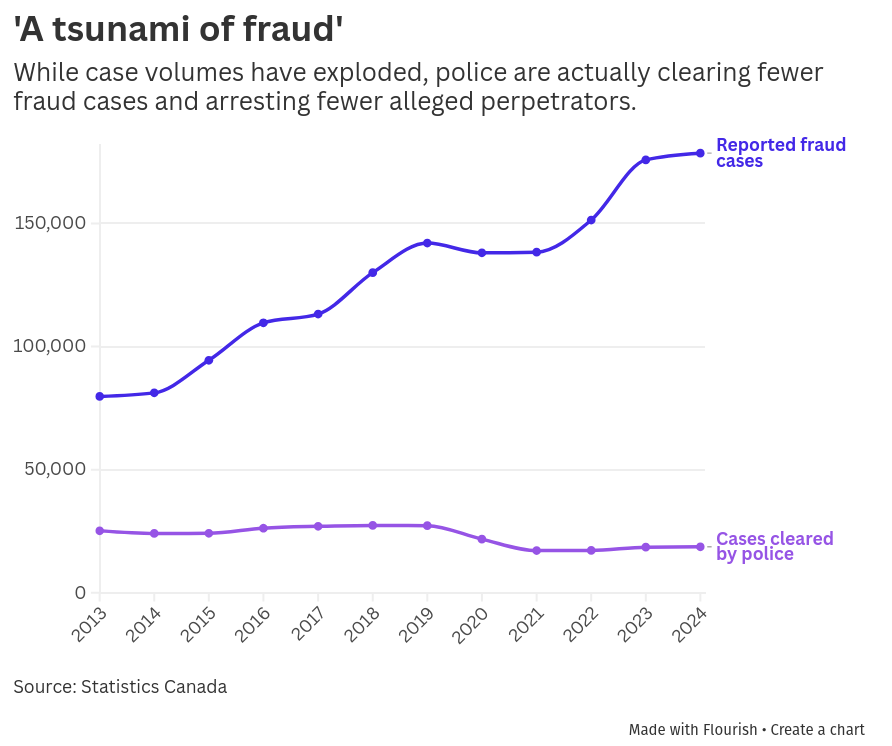
At the same time, the number of cases cleared by Canadian police has fallen. In 2013, the ratio between reported cases and cleared cases was about 3:1; by 2024, this ratio was over 9.5:1.
The vast majority of fraud cases go unsolved. This is unsurprising given that many are perpetrated over the Internet by individuals overseas and involve methods of sending money that are difficult to recover, such as crypto, gift cards, and physical transfers of cash.
In response, the National Cybercrime Coordination Centre (NC3) of the RCMP—Canada’s national police service—have built a case management system and data portal they hope will eventually be adopted by all Canadian police forces. According to the article, this system is aimed at improving coordination, data sharing, and analysis. The platform will also host a set of AI tools, though the RCMP is vague on details and which are currently implemented. The article gives a few examples: OCR allowing victims to scan gift cards used in fraud rather than typing numbers manually, a tool to classify reports to help police target their investigative resources, and a report generator to simply data sharing when investigations go international.
With the AI-enabled explosion in fraud and scams, I hope that police forces are also able to take advantage of new tools to help catch and shut down malicious actors across the globe.