
Here’s an interesting figure and accompanying passage from this 2023 preprint entitled “Machine Culture”:
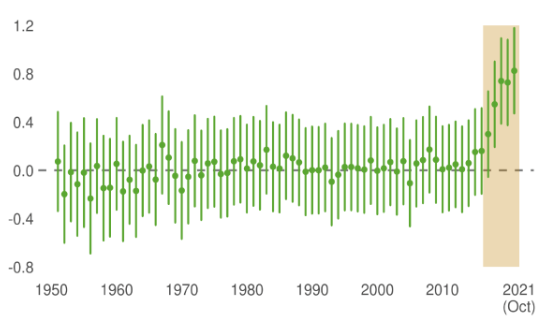
The innovations generated by AlphaGo and AlphaGo Zero soon entered human culture, as shown by research comparing human gameplay before and after the algorithms’ introduction. The decision quality, as measured by an open-source variant of AlphaGo Zero, showed very little improvement in human gameplay from 1950 to 2016, followed by a sudden improvement after the introduction of AlphaGo in March 2016. However, this improvement wasn’t solely due to humans adopting strategies developed by AlphaGo. It also reflected an unexpected shift, wherein humans started developing moves that were qualitatively distinct both from previous human moves and from the novel moves introduced by AlphaGo. In summary, AlphaGo served as an early, quantifiable exemplar of machine culture, generating novel cultural variations through genuine, nonhuman innovation. This was followed by a major transition into an even broader range of traits as the result of humans building on the previous discoveries made by machines. As the methods underpinning AlphaGo have been generalized to other games and extended to scientific problems, we anticipate a continued infusion of machine-generated discoveries across diverse domains of human culture.
As pointed out by Mickey Friedman, it’s a data point against “the current fear […] that AI homogenizes culture and turns humans into passive consumers”.