
Stephen Johnson reports in Big Think on a movement in the United States to end the fear that parents have of having Child Protective Services called on them for giving their young children some independence to roam their neighbourhoods unsupervised. In recent years, there have been several high-profile cases of parents investigated for neglect for allowing their children freedom of movement that would be considered utterly routine two decades ago.
There are many articles decrying the “helicopter parents” of today, who never let their children out of their sight. But this is rational behaviour when vague laws regarding childhood endangerment/neglect create a climate of fear: even if most people believe allowing kids independence is reasonable, all it takes is one complaint and one sympathetic social worker to create dire consequences for an entire family. This is what activists in the United States are trying to change:
The case helped persuade Georgia legislators to pass a so-called “reasonable childhood independence” (RCI) law, enacted last summer. These laws are part of a national movement to tighten vague language in states’ neglect laws. Georgia’s old law, for instance, defined neglect as the failure to provide “proper” parental care. The new law replaces that with “necessary” care and sets a higher bar for neglect: Parents must demonstrate “blatant disregard” for their child’s safety — putting them in imminent, obvious danger. The law also explicitly states that allowing a reasonably capable child to walk to school or travel to a nearby park unsupervised does not, by itself, constitute neglect.
Since 2018, 11 states have passed some form of RCI legislation. The movement generally has bipartisan support, though it travels differently depending on the audience. Diane Redleaf, a family defense attorney, notes that in red states, arguments focused on government overreach tend to land best, while in blue states, the more persuasive case centers on equity — who can afford a babysitter, and whether neglect investigations fall disproportionately on families of color.
As a kid growing up in the late 90s and early 2000s, I was granted a degree of freedom to roam my town (usually on a bicycle) that would probably be considered neglectful by modern standards (but completely unremarkable at the time). In Canada, the Criminal Code “stipulates people can be charged with abandonment for leaving a child under 10 years of age alone ‘so that its life is or is likely to be endangered or its health is or is likely to be permanently injured.’” I don’t know much about the legal state of free-range parenting in Canada, though I did find this 2018 article advocating for a “free-range parenting” law in the country.
Two years ago, I came across this letter to the editor in my home town newspaper:
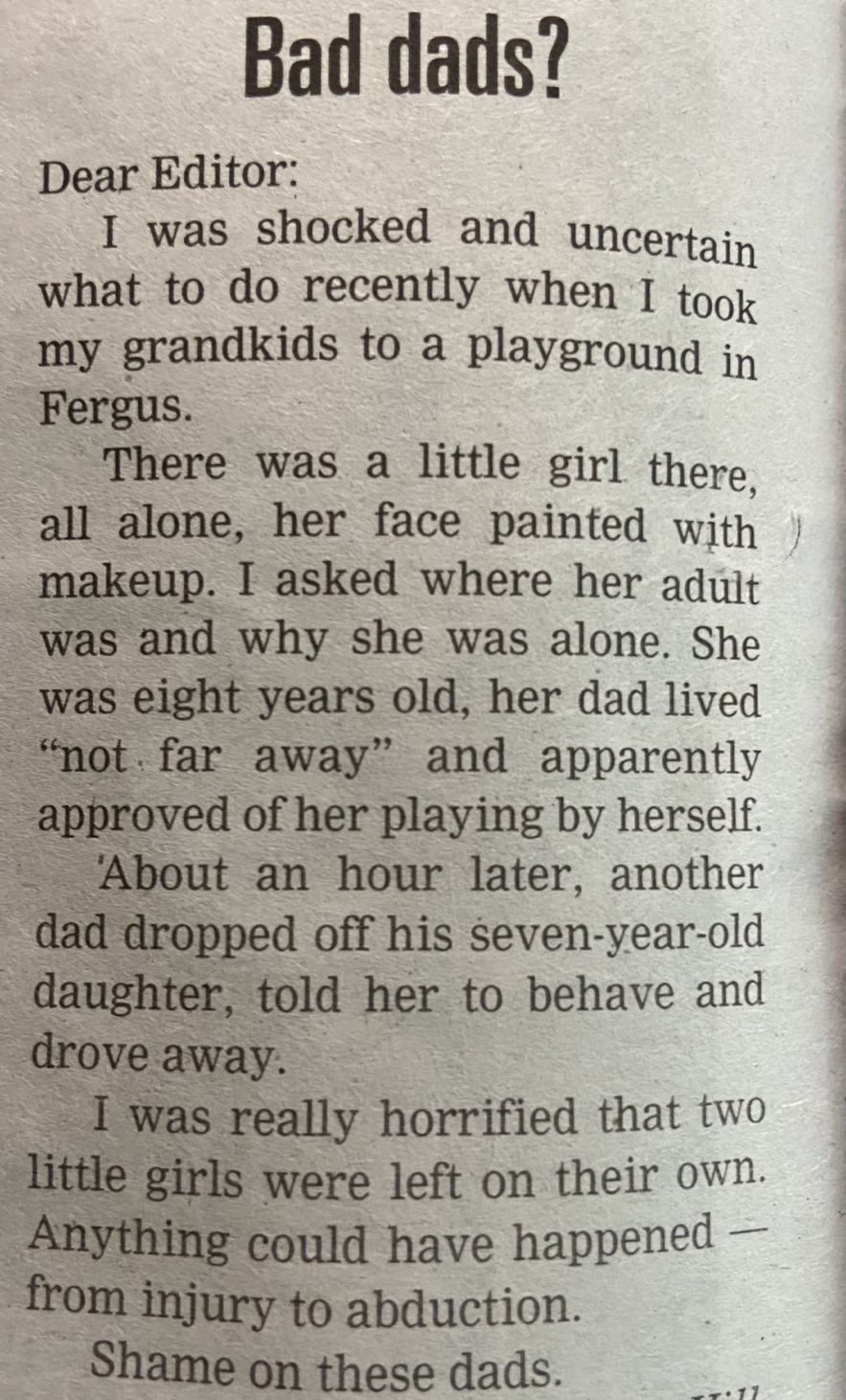
The climate of fear is alive and well, even in small town Ontario.
Hat tip to Sylvain Kalache on Hacker News.