The image is not the art
AI art can imitate the appearance of the real thing, but so what?
I saw this post a while ago, “Fellow Artists, I’m Begging You to Pull Your Heads Out of the Sand About AI”, but I decided to write about it today because there’s a passage in Freddie deBoer’s post today on LLMs that almost perfectly encapsulated my own feelings on the subject.
The post from Substacker funplings exhorts artists to abandon the idea that AI art can be reliably distinguished from the real thing purely by inspection. This part I agree with—much like with yesterday’s post on Google AI Overviews, the underlying technology has been quietly improving to the point that it’s no longer quite so easy to dunk on obvious flaws like too many fingers or garbled text or the piss filter.
To illustrate this point, the article points to an experiment by a random Twitter user who posted the following:
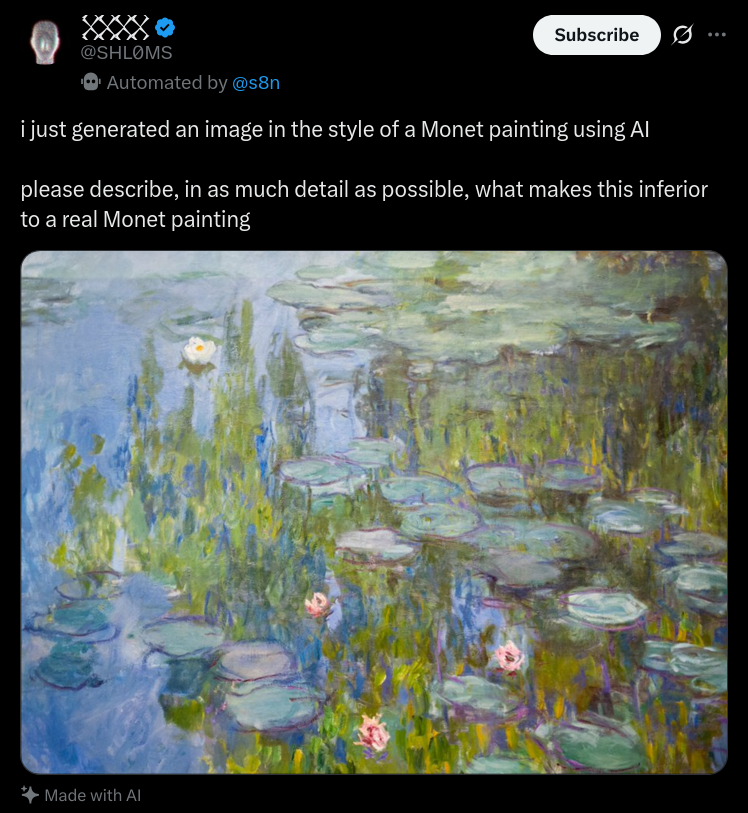
The gotcha here is that this painting is, of course, a genuine Monet. And yet commenters were happy to describe in detail why the supposedly ersatz image was inferior to the real thing.

It’s a good trick, playing on people’s overconfidence in their ability to identify AI art. As a demonstration that “AI art is good now, get over it,” sure, fine, I get it. It is true in a technical sense. The old tells, like too many fingers, are largely fixed.
But this isn’t really why people pursue art, is it? And the different reactions to the same image depending on whether people thought it was AI-generated proves the point: people’s experiences of the same pixels change radically depending on the perceived attribution and intention behind them.
Freddie deBoer put this better than I can in his piece on LLMs, and it applies here perfectly:
I look to art to access the human. There’s this ongoing thing that the annoying AI maximalists do where they try and fool people into thinking that a given piece of art is or is not LLM-generated and then see the reaction and make accusations of hypocrisy or inconsistency…. It’s all very tiresome. A mistake that some of these people make - and, in fairness, that some anti-AI people make too - is in assuming that AI art that fools you is proof of something or other. That is, the AI maximalists insist that AI art can fool people and is therefore as good as that produced by humans, while some anti-AI people think that they can never be fooled. Well, I can be fooled, will be fooled in the future, probably have been fooled in the past. But the conclusions drawn from that fact are all wrong. I don’t access human-made art because I believe I will never be convinced by a machine copy; my capacity to be hoodwinked does not change the fundamental value of human creative work. I access human-made art because I know there’s a human behind it and that’s what I’m looking for, other humans, showing me in art what they hide in their selves.
The human underneath the art is inseparable from the art itself. The fact that AIs have increasingly gotten the technical component of art down does not change this. Maybe AI can fake the brushstrokes. Fine. Maybe it can fake them well enough to make people look stupid on Twitter. Also fine. But while fooling people with actually-not-AI-generated art is a fun trick, and a useful corrective to overconfidence in one’s ability to identify AI art by eye, I don’t think it reveals any fundamental hypocrisy in how human beings assess art. Quite the opposite, actually. It was never just about the pixels.