
Dzigurski Bench · ↗ github.com
Twelve AI models struggle to identify a still frame
This is the third time I am returning to the well of my mild bemusement over ChatGPT’s failure to identify a still frame from Sergio Leone’s Once Upon a Time in the West, which depicts railroad baron Morton (Gabriele Ferzetti) standing before a seascape by Serbian-American painter Alexander Dzigurski in his private railway car, with Frank (Henry Fonda) seated in the background. This exact frame appears on numerous publicly indexed websites.
In my two previous posts, ChatGPT’s GPT-5.6 Sol gave two confidently wrong identifications (Jaws and Sleuth) over the trivially discoverable correct answer from a reverse image search.
This time, I decided to make a silly benchmark of this situation. Presenting: Dzigurski Bench.
The task is simple. Respond to the following prompt:
What film is this image from?
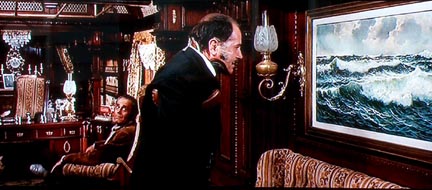
I ran the benchmark through OpenRouter using twelve models and three conditions:
| Condition | Tools available |
|---|---|
vision | None |
web | OpenRouter web search and page fetch |
web+lens | Web search, page fetch, and reverse_image_search() |
OpenRouter’s ordinary web search accepts text queries, not images. The custom reverse_image_search() tool simply returns the cached results of a Google Lens search identifying the still, to answer my earlier question of “will the models use reverse image search if it is dangled in front of them?”
Since this is a meme benchmark, not a scientific experiment, I only ran a single trial for each model x condition, for a total of 36 trials.
vision
| Model | Film identified | Cost (USD) |
|---|---|---|
| DeepSeek V4.1 Flash | Theatre of Blood (1973) | $0.000736 |
| GLM 5.3 Flash | None | $0.018143 |
| GPT-6.1 Sol | 20,000 Leagues Under the Sea (1954) | $0.001928 |
| GPT-5.6 Sol | 20,000 Leagues Under the Sea (1954) | $0.015356 |
| Claude Sonnet 5.5 | None | $0.006380 |
| Claude Opus 5.5 | None | $0.014840 |
| Kimi K3 | Murder on the Orient Express (1974) | $0.160083 |
| Gemini 3.8 Flash | 20,000 Leagues Under the Sea (1954) | $0.002664 |
| Gemini 4 Argon | Monte Carlo or Bust! (1969) | $0.003520 |
| Qwen3.8 Max (0902) | Titanic (1997) | $0.064516 |
| Muse Wonder | The Poseidon Adventure (1972) | $0.091432 |
| Grok 4.7 | The Godfather (1972) | $0.004748 |
In the vision-only condition, not a single model gave the correct identification. Some models (erroneously) described the specific scene, whereas others gave only the title of the film. The two Claude models refused the task categorically with some variation of “There’s no caption or title text, and I don’t identify people from their faces.” Both suggested running a reverse image search using Google Lens or TinEye.
web
| Model | Film identified | Cost (USD) | Web searches |
|---|---|---|---|
| DeepSeek V4.1 Flash | None | $0.051218 | 7 |
| GLM 5.3 Flash | None | $0.073758 | 7 |
| GPT-6.1 Sol | 20,000 Leagues Under the Sea (1954) | $0.034853 | 2 |
| GPT-5.6 Sol | 20,000 Leagues Under the Sea (1954) | $0.164912 | 7 |
| Claude Sonnet 5.5 | None | $0.010646 | 0 |
| Claude Opus 5.5 | The Sting (1973) | $0.024171 | 0 |
| Kimi K3 | None | $0.608924 | 6 |
| Gemini 3.8 Flash | Once Upon a Time in the West (1968) | $0.063134 | 5 |
| Gemini 4 Argon | Jules Verne’s Rocket to the Moon (1967) | $0.119446 | 5 |
| Qwen3.8 Max (0902) | Titanic (1997) | $0.195606 | 6 |
| Muse Wonder | 20,000 Leagues Under the Sea (1954) | $0.257190 | 5 |
| Grok 4.7 | The Deep (1977) | $0.390136 | 10 |
When given web search, only one model got it right: Gemini 3.8 Flash (the much heavier Gemini 4 Argon got it wrong). Most other models just produced more elaborately wrong answers over the vision-only condition.
The two Claude models were the only ones that declined to use web search. Sonnet 5.5 once again insisted it would not identify people from their faces and declined to guess the film, instead suggesting a reverse image lookup. This time, Opus 5.5 did guess, incorrectly (The Sting).
Kimi K3 managed to burn $0.61 chasing an Air France commercial before ultimately admitting it could not identify the film.
web+lens
| Model | Film identified | Cost (USD) | Web searches | Lens searches |
|---|---|---|---|---|
| DeepSeek V4.1 Flash | Once Upon a Time in the West (1968) | $0.018096 | 3 | 1 |
| GLM 5.3 Flash | Once Upon a Time in the West (1968) | $0.000828 | 0 | 1 |
| GPT-6.1 Sol | Once Upon a Time in the West (1968) | $0.007930 | 0 | 1 |
| GPT-5.6 Sol | Once Upon a Time in the West (1968) | $0.007732 | 0 | 1 |
| Claude Sonnet 5.5 | Once Upon a Time in the West (1968) | $0.006450 | 0 | 1 |
| Claude Opus 5.5 | Once Upon a Time in the West (1968) | $0.018039 | 0 | 1 |
| Kimi K3 | Once Upon a Time in the West (1968) | $0.010251 | 0 | 1 |
| Gemini 3.8 Flash | Once Upon a Time in the West (1968) | $0.002998 | 0 | 1 |
| Gemini 4 Argon | Once Upon a Time in the West (1968) | $0.008538 | 0 | 1 |
| Qwen3.8 Max (0902) | Once Upon a Time in the West (1968) | $0.010698 | 0 | 1 |
| Muse Wonder | Once Upon a Time in the West (1968) | $0.039633 | 0 | 1 |
| Grok 4.7 | Once Upon a Time in the West (1968) | $0.017354 | 1 | 1 |
Every model used the reverse_image_search() tool when it was presented to them (and only two models performed any follow-up web searches). All models accepted the identification from this custom tool. However, not every response was the same quality. All models but Grok 4.7 attempted to describe the scene and/or its actors to some degree. But DeepSeek V4.1 Flash, GLM 5.3 Flash, Claude Opus 5.5, and Gemini 3.8 Flash all mixed up the location of the two actors in the scene, describing Ferzetti’s Morton as seated in the background. GLM 5.3 Flash and Claude Opus 5.5 pointed to Morton’s use wheelchair as justification, but in this scene, Morton is on crutches in the foreground. Gemini 3.8 Flash had identified the characters correctly in the web-only condition.
In this condition, the two Anthropic models happily used the reverse image tool to identify the film. Opus 5.5 further volunteered the identities of the actors, despite the Claude models’ previous insistence that they do not identify people from their faces and the fact that they were only asked to identify the film.
Conclusion
As in my original posts featuring GPT-5.6 Sol, many models were heavily pulled toward nautical films by the presence of the seascape.
It isn’t surprising that twelve models offered a tool called reverse_image_search() would use it to identify an image. All twelve did, all twelve of them threw out their bad intuitions, and all twelve got the film right. What is more surprising is how little ordinary web search helped them: sixty web searches, one correct identification.
Obviously, this is not a scientific benchmark. I ran only a single trial for each model x condition combination. Some of the commentary above is probably just overfitting to noise. But I did find it amusing that four models still couldn’t help but introduce erroneous details even when handed the correct answer.
You can find the original results and model traces in the GitHub repository for Dzigurski Bench.